The same illness, caught at three different moments
Read the row that matters: not the size of the debt, but when somebody finally looked at it.
| Lille | Lyon | Bordeaux | |
|---|---|---|---|
| Caught | In time | At the edge | Not at all |
| Who bought it | Gérard Lopez, 2017 | John Textor, 2022 | Gérard Lopez, 2021 |
| How it was bought | At least €225m borrowed from Elliott over two years | Inside a group carrying debt of €505m | For one symbolic euro, with over €100m attached |
| Who pulled the alarm | Elliott, after Covid and Mediapro | The DNCG, November 2024 | The DNCG, July 2024 |
| What followed | Sold to Merlyn Partners, 18 December 2020 | Relegated 24 June 2025, reinstated 9 July | Receivership, 30 July 2024 |
| Where it ended | Champions of France, 2021 | Ligue 1, under a capped wage bill | Régional 1, and sold again for one euro |
Lille is the control case. The same disease, diagnosed while the club still had something to sell and someone willing to buy it.
The regulator that can relegate you before you play
The Premier League's Profitability and Sustainability Rules measure losses already made and punish them afterwards. UEFA's squad cost rule is a ratio applied to accounts already closed. Both answer the same question: what did you do last year.
The DNCG asks a different question. It reads next season's budget, before that season exists, and decides whether the club may play at the level it earned on the pitch. It can cap a wage bill, forbid recruitment, or send a club down a division without a ball being kicked.
France is not alone in looking forward. Spain sets each club a squad cost limit before the season begins — the mechanism that stopped Barcelona registering Lionel Messi, set out in the Barcelona piece, and in its effects a harder constraint than anything the DNCG imposes.
What is unique to France is the sanction attached. A Spanish club that breaches its limit cannot sign players. A French club that fails its budget review can be sent down a division.
And in the last five years, French football has watched a six-time champion fall to the sixth tier, and a Champions League regular come within fifteen days of Ligue 2. Both statements are true at once, and the second is not an argument against the first.
The illness
Strip the three stories of their personalities and the same structure appears in each.
A buyer acquires a club with money he has borrowed rather than money he has. The debt sits on or around the club, and it has to be serviced out of something. In football there is only one line that produces cash quickly and in size: selling players.
Four ways a club earns. One way it repays.
Nothing here is illegal and nothing here is unusual. It works for exactly as long as two external numbers keep rising.
A club earns from broadcast rights, from matchday, from commercial deals and from selling players. The first three arrive in instalments and leave again as wages, and they are spoken for before the season starts. Only the fourth can produce a large sum on demand — which is why an owner who borrowed to buy ends up depending on it. Read the red arrow right to left: the club is not the source of the repayment, it is the corridor.
None of this is improper, and none of it is rare. It is the ordinary logic of a leveraged acquisition, applied to an asset whose revenue is not contractual. It needs two external numbers to keep rising — the price the transfer market will pay, and the broadcast income underneath it.
In France both stopped inside the same decade. Domestic broadcast rights fell from around €500m a season to a range of €180m to €220m, a drop of more than half. And a club that is known to need a sale does not get the price a club that can wait gets — the mechanics are set out in the piece on Brighton, where the same cycle runs with the bargaining position the right way round.
Lille, 2020: caught in time
Gérard Lopez bought Lille in 2017. The purchase was financed by borrowing — at least €225m over the first two seasons, lent by the American fund Elliott Management at rates the *Financial Times* put in double digits — and the model meant to repay it was the one Lille became famous for: recruit young, develop, sell at a multiple.
It produced remarkable football. It did not produce enough cash. In March 2019 Elliott and Lopez recapitalised, writing off €142m of debt to clear the balance sheet.
Then two things arrived at once that had nothing to do with the squad. Covid emptied the grounds. And Mediapro, the broadcaster that had bought Ligue 1's rights and then could not pay for them, walked away — the first French television collapse, four years before the one this article has been describing. The income the model assumed simply stopped.
What saved Lille was not the regulator. It was the creditor. Under pressure from Elliott, which could not recover what it had lent, Lopez ceded the holding company, Victory Soccer Limited, to a vehicle controlled by the fund Merlyn Partners. The sale completed on 18 December 2020, and Olivier Létang became president the same day.
The financial debt at the handover was around €200m, owed principally to Elliott and to JPMorgan. The club's full balance sheet at the end of the following season showed €254m, of which €133m fell due before June 2022.
Five months later Lille were champions of France.
That sequence is worth holding on to, because it is the only one of the three in which the problem was identified while the club still had something to sell and somebody willing to buy it. Lille did not recover because the system worked. It recovered because a creditor moved before the system had to.
Lyon, 2025: caught at the edge
Lyon is the case that shows what the regulator can do, and what doing it costs.
By the autumn of 2024, debt across John Textor's Eagle Football group was reported at around €505m. In November the DNCG imposed a conservatory relegation to Ligue 2 — a provisional sanction, to be confirmed or lifted once the club had shown it could fund the following season.
What followed was eight months of a club trying to buy back its own division. Eagle injected €83m in January 2025. Players were sold, the wage bill came down, shareholders put more in. On 24 June 2025 the DNCG confirmed the relegation anyway. The club announced it would appeal immediately.
Lyon: eight months, and then fifteen days
The clearest demonstration that this regulator's decisions are reversible, and that reversing one costs money.
- Autumn 2024The number appearsGroup debt reported at around €505m.
- Nov 2024Conservatory relegationThe DNCG provisionally sends the club to Ligue 2.
- Jan 2025€83m injectedEagle Football puts money in. Players are sold; the wage bill falls.
- 24 Jun 2025Relegation confirmedThe club announces it will appeal immediately.
- 30 Jun 2025The owner changesMichele Kang replaces John Textor as president.
- 9 Jul 2025ReinstatedThe appeal commission overturns the decision. Wage bill and transfer fees capped.
The €124m was not the debt. It was the cash the regulator required to be shown: €87m immediately available and €37m in firm guarantees. Group debt, over €500m in 2024, stood at €409.8m in 2026.
Six days later Textor stepped aside and Michele Kang became president. On 9 July the appeal commission overturned the decision, and Lyon stayed in Ligue 1 with its wage bill and transfer spending capped. *L'Équipe* reported that around €124m had to be found to obtain the reversal; Kang declined to confirm the figure.
Fifteen days separate the two decisions. The club did not change in those fifteen days. Its owner did.
Bordeaux, 2024–2026: not caught
In July 2021, seven months after leaving Lille, Gérard Lopez bought the Girondins de Bordeaux. The seller was King Street, an American fund that had bought into the club alongside GACP in November 2018 and taken sole control a year later. It was walking away.
M6 had sold the Girondins to those buyers for €100m. Less than three years later the club changed hands for one symbolic euro, with more than €100m of debts and commitments attached to it.
Nothing in French football law required anybody to ask what had just happened at Lille.
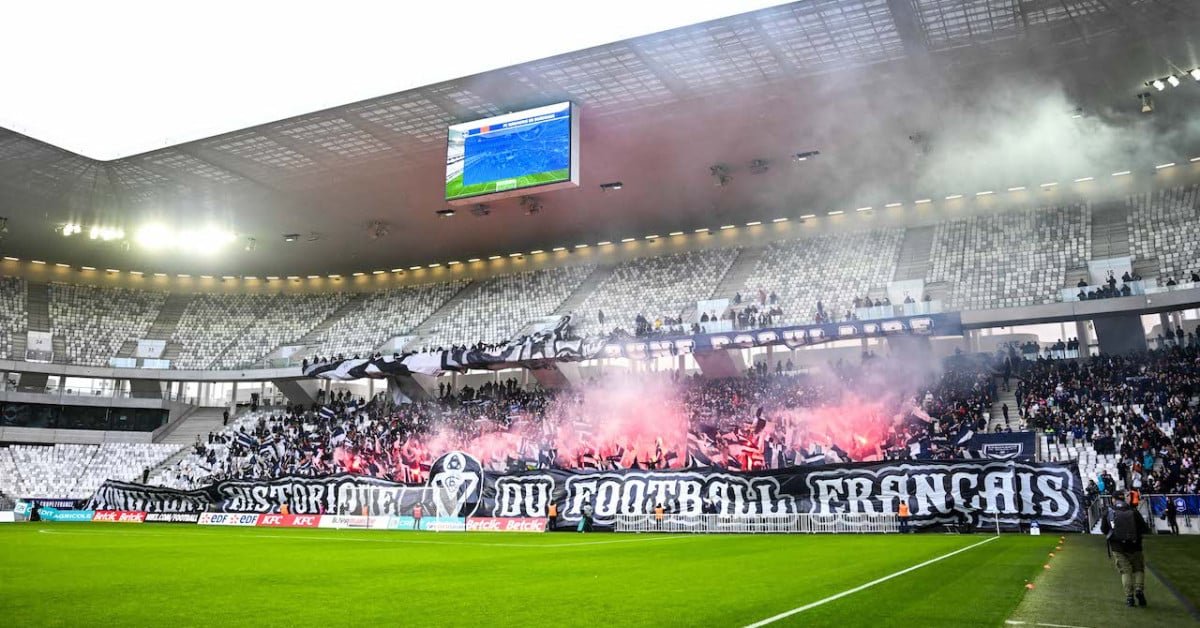
The Girondins were champions of France six times. They are now in Régionale 1, which is the sixth tier, and every step down was taken in an office.
Bordeaux: from €100m to one euro
Every step below was taken by a regulator, a court or a seller. None of them on the pitch.
- Nov 2018Bought for €100mKing Street buys the club from M6 alongside GACP, taking sole control in December 2019.
- Jul 2021Bought for €1Gérard Lopez acquires it from King Street, with more than €100m of debts and commitments attached.
- 9 Jul 2024Down to NationalFirst administrative relegation. The appeal is withdrawn on 23 July, after talks with Fenway Sports Group fail.
- 30 Jul 2024Receivership€94m owed to nearly 400 creditors. Professional status given up, academy closed.
- 1 Aug 2024Down again, to National 2The receivership triggers a second relegation. Confirmed on appeal on 12 August.
- 2025Continuation planTen years. Write-offs bring the debt due down to around €25m.
- 30 Jun 2026Régional 1Relegated once more, for want of sufficient finances.
- Sept 2026Sold for €1Lopez cedes to the British fund Park Bench, which commits close to €18m. A new plan spreads €13m to €14.5m out to 2038.
€100m in 2018. One euro in 2021. One euro in 2026. Six times champions of France, and two administrative relegations inside a month.
What followed is the sequence the regulations prescribe, applied without discretion, and it ran twice in a month.
On 9 July 2024 the DNCG relegated the club from Ligue 2 to National, the third tier. Bordeaux appealed, then withdrew the appeal on 23 July when talks with Fenway Sports Group came to nothing, and entered receivership on 30 July owing €94m to nearly four hundred creditors. That receivership triggered a rule of its own: a club under the procedure drops one division below the one it had qualified for. On 1 August the federal commission sent it down again, to National 2. The appeal against that second relegation was rejected on 12 August.
Two administrative relegations in twenty-four days, neither of them decided by a result. In between, the club surrendered its professional status and closed an academy that had produced internationals for forty years.
It should be said plainly that Lopez did not take money out of Bordeaux. He put €38m in and wrote it off, presented a €4m budget to the commercial court, and asked for the receivership himself rather than let the club be liquidated. The plan approved in 2025 brought the €94m owed to nearly four hundred creditors down to around €25m, spread over ten years. The club escaped liquidation.
It escaped into the fourth tier, and then kept falling. In June 2026 it went down once more, to Régional 1, for want of sufficient finances.
In September 2026 Lopez sold the club to the British fund Park Bench, for one symbolic euro, with the renegotiated debt attached and a reported commitment of close to €18m from the buyer. A further plan now spreads between €13m and €14.5m out to 2038.
He bought it for a euro and sold it for a euro. Five divisions separate the two transactions.
This piece is not an argument about one man. It is an argument about the fact that in 2021, when he bought his second French club, there was no procedure in existence that could have required anyone to look at the first.
The rules caught the club. They did not save it, and by the time they bit, there was very little left to protect.
That is not a criticism of the DNCG. It is a description of what a budget regulator can and cannot do. By the time a club's budget fails, the thing that caused it to fail happened years earlier, somewhere the regulator was not allowed to look.
Nobody was allowed to say no
Read the three stories back to back and the common element is not incompetence. It is a gap in the law.
The DNCG could examine a budget and refuse it. It could not examine the person who had just bought the club. A seller and a buyer agreed a price, signed, and French football met its new owner at the same moment as the public did. Whether he had borrowed the purchase price, what he owned elsewhere, what his previous five years looked like — none of it was anybody's business, because nobody had been given the power to make it theirs.
So the control arrived late, every time, and always in the same form: a budget hearing, two or three seasons after the fact, by which point the question was no longer whether to approve an owner but whether to relegate a club.
Which is how the buyer who had just handed over a club carrying €200m of financial debt was able, seven months later, to acquire another one for a euro, with nobody obliged to connect the two.
The law that closed it
That changed with law no. 2026-725 of 3 August 2026, on the organisation, management and financing of professional sport, which created article L. 133-1 of the Code du sport.
What was examined, and what is examined now
The gap was never enforcement. It was jurisdiction.
Before August 2026the club only
Since August 2026the owner too
The second row is the one that matters. The statute uses the past tense: clubs over which the candidate exercises or has exercised control. It is written for exactly the case this article describes.
A change of control at a French professional club now goes to the regulator before it completes. The body has three months from notification to rule, and it must give reasons. It may approve the deal, approve it subject to conditions or reserves, suspend it for up to three months while it checks further, or refuse it outright — and it may refuse only where one of the risks the statute lists is present and no condition can prevent it.
Those risks are three. That the deal breaches the multi-club rules set out in the piece on groups. That it damages, immediately or in time, the club's finances or the unpredictability of the contest itself. Or that it offers insufficient guarantees to put the club's finances right.
And what the body weighs, in making that judgement, is the buyer. His stake in other clubs in the same sport. His own financial results over five years. And — the provision that matters most here — the financial results, over five years, of any club in the same sport over which he exercises **or has exercised** control or notable influence.
The statute is in the past tense. It was written for the case this article has just described.
Apply it to 2021. A candidate buying Bordeaux would have arrived carrying five years of his own accounts and five years of Lille's, and the regulator would have been required to read both before anybody signed anything.
The parts nobody is talking about
Three further provisions deserve more attention than they have had.
The body's composition is now fixed by law: at least two thirds of its members must be professionals qualified in law, accounting, audit or finance, holding no office in the federation or the league and no shareholding in any club. Independence has stopped being a convention and become a quorum.
The accounts are watched continuously rather than annually. Where a commissaire aux comptes opens an alert procedure, the club must inform the regulator without delay — the warning now reaches the regulator at the same time as the board.
And there is a sanction for accounts that do not describe reality. Where forecast and executed operating accounts diverge significantly in a way that shows a manifest intention to conceal, or to present the accounts misleadingly, the body may impose financial and sporting penalties. Which is, in French law and in two sentences, the charge sheet that took the Premier League eight years to litigate in the Manchester City case.
Who gets to speak
One last provision, and it has no equivalent anywhere else in European football.
When a takeover is examined, an approved supporters' association of the club, a national supporters' body, or the local authority where the club is based may ask to be heard — and must be. The sports minister may issue a public reasoned opinion of his own, on the sporting dimension of the deal: specifically, on the commitments made about the academy and the infrastructure.
Bordeaux closed an academy that had produced internationals for forty years. Under the law as it now stands, somebody would have had to be asked about that, in public, before the sale.
What it looks like in practice
The first visible effect was not a rejection. It was a sale that never reached the room.
On 22 October 2026, Waldemar Kita ended exclusive talks to sell FC Nantes, reportedly valued at €125m including bonuses. According to local press reports, the bank guarantees Kita had required never arrived, and the file needed for approval was never assembled. The DNCG was not called upon to rule on anything.
That is the whole point, and it is easy to miss because nothing dramatic happened. Under the previous regime, a buyer who could not evidence his guarantees within the time allowed would have become the owner of an eight-time French champion, and the regulator would have met the consequences at a budget hearing two seasons later.
Which is, to the letter, what happened at Bordeaux.
What it does not fix
A filter at the door does not treat the patients already inside. Bordeaux is in the sixth tier whatever the law now says about acquisitions, and Lyon and Marseille went into 2026/27 with their wage bills under supervision.
There is also the question of where the new regime stops. Bordeaux changed hands again in September 2026, a month after L. 133-1 came into force, for one symbolic euro. The club had surrendered its professional status two years earlier — which is precisely the point at which the regulator's writ runs out. The clubs furthest down the slope are the ones the filter no longer covers.
Nor does it touch the thing that actually broke. The collapse of domestic broadcast income is not an ownership failure and no approval process can prevent it. A regulator can stop the wrong buyer arriving. It cannot restore €300m a season to a league.
There is also a design choice in the statute worth noticing. If a deal is completed in defiance of a suspension or a refusal, the penalties — a ban on promotion, relegation, exclusion from competition — fall on the club. Not on the buyer who ignored the decision, and not on the seller who took his money. On the institution, and on the people in the stands. It is the same pro-cyclical instinct that sent Bordeaux down: the only lever the regulator holds is one that damages the thing it is protecting.
And it introduces a question nobody in France has answered yet. What happens to the value of a club that can only be sold to a buyer the regulator approves? A restricted market is a smaller market, and a smaller market prices lower. The protection is real. So is the discount.
England is about to run the same experiment on a larger scale, with a statutory regulator of its own and a first report that reads like an autopsy performed on a living patient. That is the subject of the next piece.